
Four Faces, Different Eras: Collecting KISS

The Demon, the Starchild, the Spaceman and the Catman remain recognisable even when almost everything around them changes. Put the faces above a business suit, enlarge the head into a Funko shape, or surround the figure with the machinery of Psycho Circus: the identity survives. That makes KISS collectibles unusually good objects to compare.
The interesting question is how each manufacturer translates the band. Some figures concentrate on stage costumes and instruments. Others turn an album into a scene, or take the imagery into something closer to a comic-book world. The selection here brings together stock pieces from Niflheim’s catalogue and one clearly identified preorder. It offers several ways to build a collection around an era, a character or a particular kind of object.
KISS collectibles: choose the idea before the size
A collection becomes more coherent when you know what connects it. Four matching characters from one range give you a complete visual language. Several versions of one character let you study how that identity changes. Collecting by album creates a third route: the object becomes a reminder of a particular record and its artwork.
Scale is part of that decision, but a height measurement does not tell the whole story. A compact figure with an oversized head may command more attention than a taller, more naturalistic figure. Instruments, bases, companions and retail packaging also affect the space needed. Compare photographs and listed dimensions before assuming pieces from different manufacturers will look like one uniform band.
Psycho Circus: the band enters another world
McFarlane’s 1998 Psycho Circus set makes the most of the distance between a musician and a character. The complete set shown here contains all four packaged pairings: Gene Simmons with the Ring Master, Paul Stanley with the Jester, Ace Frehley with the Stiltman, and Peter Criss with the Animal Wrangler. The circus figures are separate companions, not alternative names for the musicians.
Psycho Circus: Gene Simmons paired with the Ring Master Psycho Circus: Ace Frehley paired with the Stiltman Psycho Circus: Paul Stanley paired with the Jester Psycho Circus: Peter Criss paired with the Animal Wrangler
That distinction changes how the set reads. Each package is a small encounter between the familiar KISS identity and a stranger from the circus. Seen together, the four packages create a much larger imagined setting than four musicians standing in a line. It is a route into KISS collecting for someone who is as interested in theatrical world-building as in a stage likeness.
The complete Psycho Circus set: all four retail packages Psycho Circus: side view showing aged blister plastic Psycho Circus: close view of the packaging condition
The physical condition deserves equal attention. These packages remain sealed, but the photographs show storage wear, scuffed plastic and yellowing. Sealed tells us about the package’s opening history; it does not mean the cardboard and blister are untouched by time. A complete vintage set with visible age offers a different collecting experience from a new release with crisp packaging.
Explore the complete McFarlane Psycho Circus set, including the individual package and condition photographs.
Creatures: instruments, stance and stage presence
The McFarlane Creatures Series 5 figures return the focus to the performer. The Starchild is presented with a guitar, the Demon with a bass. Those instruments help define the figures’ outlines and keep the association with a working band visible beneath the costumes and makeup.
McFarlane Creatures Series 5: Starchild with guitar in the original package McFarlane Creatures Series 5: Demon with bass in the original package Creatures Starchild: close view of damage at the lower-left package area
The two photographed releases belong to McFarlane’s six-inch-scale range. For a display, compare the stance and the space around the instrument as well as the stated scale. A figure whose accessory extends sideways may require more room than its height suggests. For a sealed collection, the shape and condition of the blister become equally important because they remain part of what you see.
The Starchild package has visible damage around the lower-left area. That is a useful reminder to look beyond a recognisable front image: corners, edges, hanging tabs and clear plastic all contribute to the condition of a packaged figure. The detailed listing should guide the purchase, rather than a general assumption that old stock is pristine.
See the Creatures Starchild / Paul Stanley and Creatures Demon / Gene Simmons listings.
Love Gun Spaceman: the effect of fabric
Mego’s approximately 20-centimetre Love Gun Spaceman introduces another material language. Fabric clothing changes the way light falls across a figure and the way a costume sits on the body. Folds and layered edges read differently from costume details moulded into a solid surface.
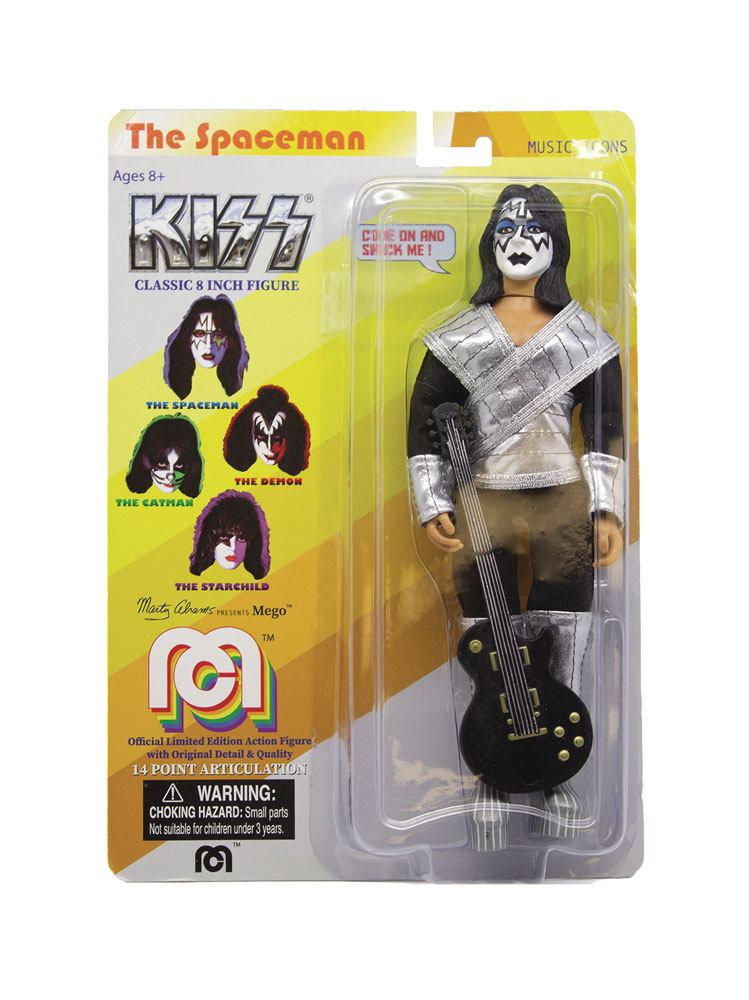
This can be a satisfying centrepiece for a collection focused on the Spaceman identity. It also invites a comparison with the smaller Funko version below: the face remains legible while the proportions, surface and relationship to the costume change substantially. One does not have to replace the other; the difference is the reason to put them in conversation.
View the Mego Love Gun Spaceman figure.
Four Funko figures, one consistent visual language
The Funko POP! Sayings releases bring all four identities into the same stylised system. The Demon is number 471, the Starchild 472, the Spaceman 473 and the Catman 474. The speech bubbles add another visual element, turning the idea of a sung chorus into something physically attached to the figure.
Funko POP! Sayings: Demon number 471 Funko POP! Sayings: Starchild number 472 Funko POP! Sayings: Spaceman number 473 Funko POP! Sayings: Catman number 474
Look at what has to survive the simplification: the star, the eye shapes, the contrasts in the makeup and the silhouette of the costume. Tiny anatomical detail matters less here than the placement of a few recognisable marks. Displaying all four makes those differences easier to appreciate because the underlying proportions are shared.
Demon number 471: retail box and figure Starchild number 472: retail box and figure Spaceman number 473: retail box and figure Catman number 474: retail box and figure
The listings give the Demon, Starchild and Spaceman at approximately nine centimetres, while the Catman is listed at twelve. A matching range therefore still benefits from checking individual dimensions. If you keep the boxes, allow for the box footprint as well as the figure itself. The numbered fronts make a different kind of display from the loose figures.
Preorder: Dressed to Kill in three dimensions
NECA’s Dressed to Kill four-pack takes a specific photographic moment as its starting point. The manufacturer identifies the 1975 New York album-cover photo shoot as the reference: the four musicians appear in business suits while retaining the makeup that makes the juxtaposition work. The seven-inch-scale figures are articulated and presented as a complete set in collector packaging. See NECA’s description of the release.
NECA Dressed to Kill: four articulated figures in business suits — preorder NECA Dressed to Kill: collector packaging — preorder NECA Dressed to Kill: staged manufacturer photograph recalling the album-cover scene — preorder
This is a different kind of album collectible from a record sleeve reproduced as a flat image. Posing the figures lets the owner reconstruct the group’s arrangement and consider the small differences between them. The suits also make the faces more conspicuous: remove the extravagant stage costumes and the makeup still carries the identities.
The Niflheim listing is a preorder, not an item available for immediate dispatch. Its product page carries the current estimated shipping information and ordering conditions; release estimates can change. This preorder is listed for delivery within Germany. Use the shop’s information for this order rather than assuming that another retailer’s or the manufacturer’s release schedule is identical.
View the Dressed to Kill four-pack preorder.
A smaller object with a different purpose
Figures are only one way to keep the band’s visual history close. The KISS Photos playing cards use photographs across a functional deck. The listing is for one 54-card deck, comprising 52 playing cards and two jokers. The catalogue image shows a retail display containing several decks; it should not be read as the quantity supplied for one purchase.

For someone who enjoys the imagery but has limited shelf space, a deck offers a different relationship with it: the pictures emerge through handling and play. Explore the KISS Photos playing cards.
Build around the KISS that interests you
Psycho Circus suits a collection drawn towards fantasy and elaborate packaging. The Creatures figures put instruments and stage identities forward. Mego gives the costume a textile presence, Funko makes the four faces into a compact graphic system, and Dressed to Kill turns an album photograph into a scene.
Start with the era or visual approach that keeps drawing your attention, then check the actual edition, scale, completeness and condition. The stocked pieces and the preorder serve different timelines, so consult each product page for current availability. For the records behind the imagery, continue with our personal ranking of every KISS studio album. A collection is more rewarding when its objects lead you back to the music.

Comments