
The Design of Horror

A creature’s outline can be as important as its face. Malpuss, a ten-centimetre resin cat from Nemesis Now’s Cult Cuties range, spreads a pair of bat wings from a seated body. NECA’s Bat Gremlin reaches a wingspan of approximately 45 centimetres. Before we study either face, the wings have already told us something about the creature—and the space it needs.
Horror collectibles reward this kind of attention. A horn changes a familiar animal. A hood turns a face into something emerging from darkness. A mask can survive a radical change of proportion and remain recognisable. These decisions give an object its character, whether it stands on a shelf, folds into a ball or appears in the illustration of a puzzle.
Looking closely also makes collecting more personal. You begin to notice which shapes, textures and expressions hold your attention. The following pieces offer a way into that process, beginning with the small creatures of Cult Cuties.
Cult Cuties: a family of different silhouettes
Nemesis Now identifies Cult Cuties as a collection created by its in-house design team. Across these seven designs, dark surfaces, large eyes and silver-coloured details establish a family resemblance. Individual characters then change the outline: wings, horns, a hat, a hood or several heads sharing one body.
Malpuss Pawzuph Purrah
The Malpuss figure makes that outline especially clear. Its upright ears and outstretched wings create a broad upper half above neatly gathered paws. Fine fur texture softens the body, while the smooth wing membranes give the sides a different surface. At approximately ten centimetres high, it is a compact sculpture with a surprisingly expansive shape.
Pawzuph carries its height in a pair of curled horns. The seated cat’s posture remains composed, and the pale markings across the forehead draw the eye between the horns. At approximately eleven centimetres, it sits close to Malpuss in scale, but the concentration of detail above the face gives it a different emphasis. Putting them together makes the difference immediately visible.
Purrah builds a character through clothing. A tall, bent witch’s hat extends the silhouette, its broad brim casting a line across the face. A cape wraps around the body, with a small fastening at the neck. The hat makes this figure recognisable even from a distance; the fur, face and small decoration reward a closer look.

Those three pieces suggest a useful way to approach the range: start with the form that interests you. Malpuss spreads outward. Pawzuph draws attention upward. Purrah creates a figure within a costume. Their shared palette allows them to sit together without making them interchangeable.
Zefur Beelzebat Diabarkus
The hood of Zefur frames the face with a pale border. It creates a deep, enclosed shape around the eyes, while the robe falls into a broader base decorated with small skulls. Viewed beside Purrah, the two show how much clothing can do in a small sculpture: one opens the silhouette with a brim; the other encloses it with a hood.
Beelzebat brings its wings around the front of its body. Their curved edges create a compact shape beneath the head, and the silver-coloured claws and wing details interrupt the dark surface. It is the smallest figure in this selection, listed at approximately nine centimetres. The folded wings make it a particularly useful companion to the open-winged Malpuss.
Diabarkus takes a different route altogether. Three dog heads share a seated body, with the central face looking forward and the side heads extending the width. Each face has its own angle and expression. The collars help divide the heads visually, while a pointed tail continues the creature’s character around the back.
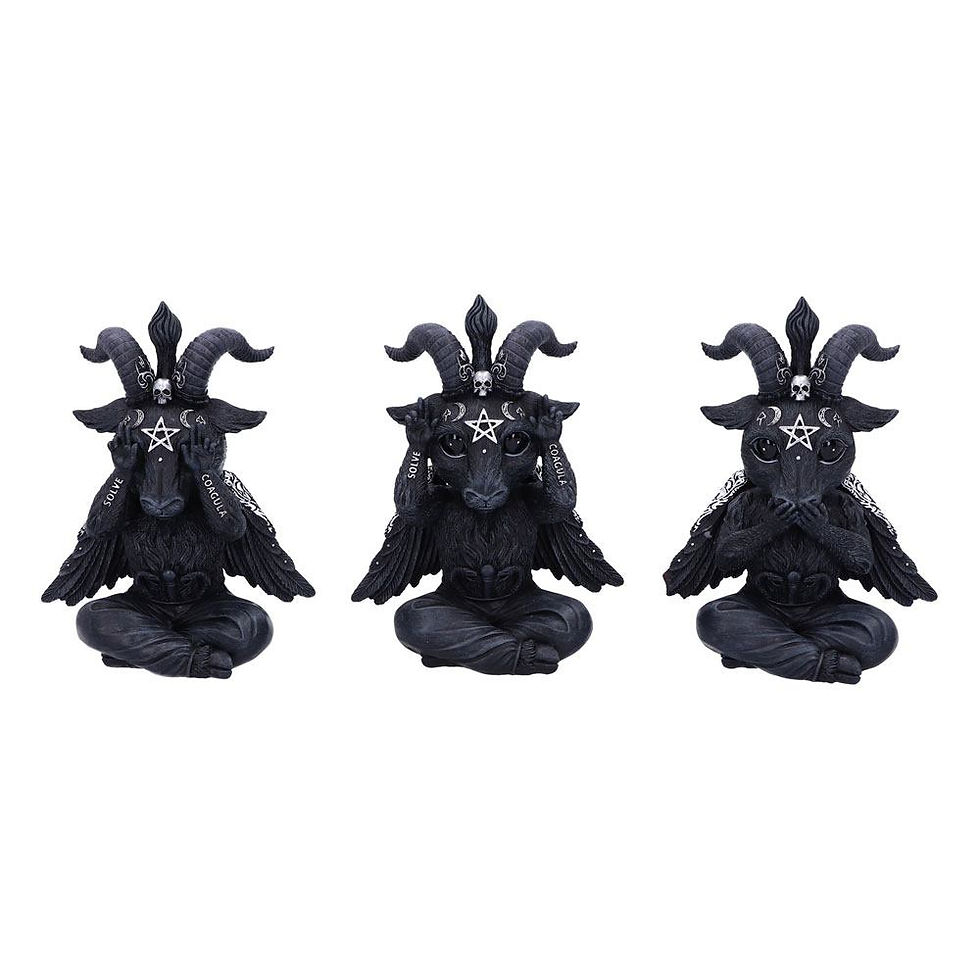
The Three Wise Baphoboo set develops variation through gesture. Three horned figures cover their eyes, ears and mouth. Their shared shape makes the changed hand positions easy to read. Displayed as a group, they create a small sequence; the relationship between the figures becomes as important as any individual face.
These are resin display pieces described as hand-painted in the product listings. Their appeal lies in the choices visible in each sculpt: the shape of a wing, the weight of a hood, the position of a paw. That gives a collector plenty to compare within one coherent series.
Turn the figure around
The front view introduces a character. Other angles show how the design has been carried through the object. Malpuss’s rear view reveals the span of the wings and the fur running down the back. Diabarkus’s heads form a different pattern from behind, while its curled tail gives the lower body a more elaborate outline.
Malpuss — rear view Diabarkus — rear view Beelzebat — wing detail
Beelzebat’s close-up makes the folded wing easier to understand. Its upper edge, silver-coloured details and smooth membrane create a distinct surface against the textured body. Looking at this view alongside the complete figure helps explain how the small object is put together visually.
Zefur — face detail Baphoboo — face detail
Zefur and Baphoboo reward a closer view of the face. The hood around Zefur and the horns above Baphoboo establish the overall shape; small markings, the surfaces around the eyes and the details between the horns then give the gaze a setting. It is worth looking at both distances before choosing: the object as a whole, then the areas you will want to keep examining.
Gremlins: wings, texture and movement
The NECA Bat Gremlin from Gremlins 2 makes wings the dominant feature. The figure is approximately fifteen centimetres high, with a wingspan of approximately 45 centimetres. That difference matters when planning a display: a height measurement alone would give a poor impression of the space the open wings occupy.
Bat Gremlin — open wings Bat Gremlin — display photograph
The supporting structure of each wing breaks up the membrane into separate areas, while the uneven edges give the outline a ragged character. Large ears and an open, tooth-filled mouth keep the head readable within that wide shape. The pictured display also shows how strongly the creature responds to its surroundings: an architectural backdrop gives the outstretched wings a setting and a sense of scale.
NECA’s figure includes articulated ears, jaw and arms, wings that can open and fold, and a flight display stand. Those features make the pose part of collecting it. A narrow arrangement and a fully spread silhouette ask different things of the shelf. Check the space around the figure as carefully as the height above it.
The SD Toys transforming Gizmo plush explores a different set of properties. Its brown-and-white fabric, large ears and rounded body give the character a soft physical form. Listed at approximately 31 centimetres when opened, it can fold into a furball and open again through a concealed zipper.
Gizmo — open form Gizmo — furball form
The furball changes the complete outline of the object. In the open form, the ears, eyes and paws carry Gizmo’s identity; folded away, the two-colour surface becomes the main feature. It is a transformation built into the material and construction. Alongside the Bat Gremlin, it makes a useful comparison between a poseable creature and a character whose shape can be packed away into itself.
A familiar face in changed proportions
A recognisable character can retain its identity through a substantial change of form. Michael Myers offers a particularly direct example: pale mask, dark eyes, coveralls and knife remain powerful identifying details across very different collectibles.
Michael Myers — NECA Michael Myers — TUBBZ
The NECA Halloween Resurrection Michael Myers figure uses human proportions and a mask with an impassive expression. In the product photograph, blue light catches the face and clothing while the surrounding darkness helps isolate the figure. At approximately eighteen centimetres high, it lends itself to a scene built around posture and lighting.
The Michael Myers TUBBZ Boxed Edition compresses the character into a duck-shaped PVC figure. The outline changes, but the mask, coveralls and knife remain. Looking between the two makes the essential visual cues easy to identify. A collector’s preference may come down to the treatment of the character as much as the character itself.
Horror puzzles: spending time with an image
A puzzle gives horror artwork a different pace. You become occupied with individual parts of the image: a patch of light, the edge of a face, foliage or a change in colour. The complete composition gradually returns as those small decisions accumulate.
IT / Pennywise — 500-piece puzzle Friday the 13th — 500-piece puzzle
The illustrated packaging of the IT / Pennywise In the Woods puzzle places the clown’s face prominently within a composition of warm and cool colours. The gaze and pale features provide an immediate focal point. On the Friday the 13th In the Woods puzzle, a solitary masked figure appears within a wooded setting. Branches and foliage occupy more of the composition, making the surroundings part of its atmosphere.
Both editions contain 500 pieces and list a finished size of 35 × 48 centimetres. Their different compositions offer a useful choice: a prominent face with strong colour changes, or a figure read through its environment. Piece count tells you the scale of the activity; the image helps you decide which scene you want to spend time reconstructing.
The coffin-shaped boxes also deserve a look. Their shape carries the horror theme into the packaging, making the object recognisable before it is opened. The photographs here show those boxes and their printed artwork; they are not photographs of completed puzzles.
How to choose horror collectibles you will keep noticing
Begin with the thing that draws your eye. It might be Malpuss’s open wings, the hood around Zefur’s face, the three heads of Diabarkus or the reach of the Bat Gremlin. A precise reason for liking an object is often more useful than trying to assemble a complete list of famous characters.
Then consider how you want to engage with it. A resin sculpture offers a fixed form to examine from different angles. An articulated figure lets you arrange a pose. Gizmo’s plush changes shape through its construction. A puzzle asks you to rebuild an illustration. Each gives you a different way to spend time with the design.
Finally, look at the place the object will occupy. Wings need width, horns need clearance, and dark surfaces benefit from enough light to show their detail. A pair of related pieces can make a comparison clearer; a small group can establish a rhythm of repeated shapes. Leave enough room for the characteristic that made you choose each one to remain visible.
The strongest collection develops through those decisions. Its objects continue to offer something to look at after the first recognition has passed: an expression, a texture, a relationship between figures, or an image that becomes more familiar through attention.
Explore the linked pieces above or browse the Niflheim Records collectibles selection. Current prices and availability are shown on the individual product pages.
For a broader look at physical horror culture, read Blood on the Shelf: Why Horror Was Made to Be Collected.
Product details were checked against the exact Niflheim listings. Visual observations refer to the product photographs shown here; this article is not a hands-on review. Nemesis Now’s Cult Cuties collection provides the design-team attribution.

Comments